How Solar Garden Lights Work
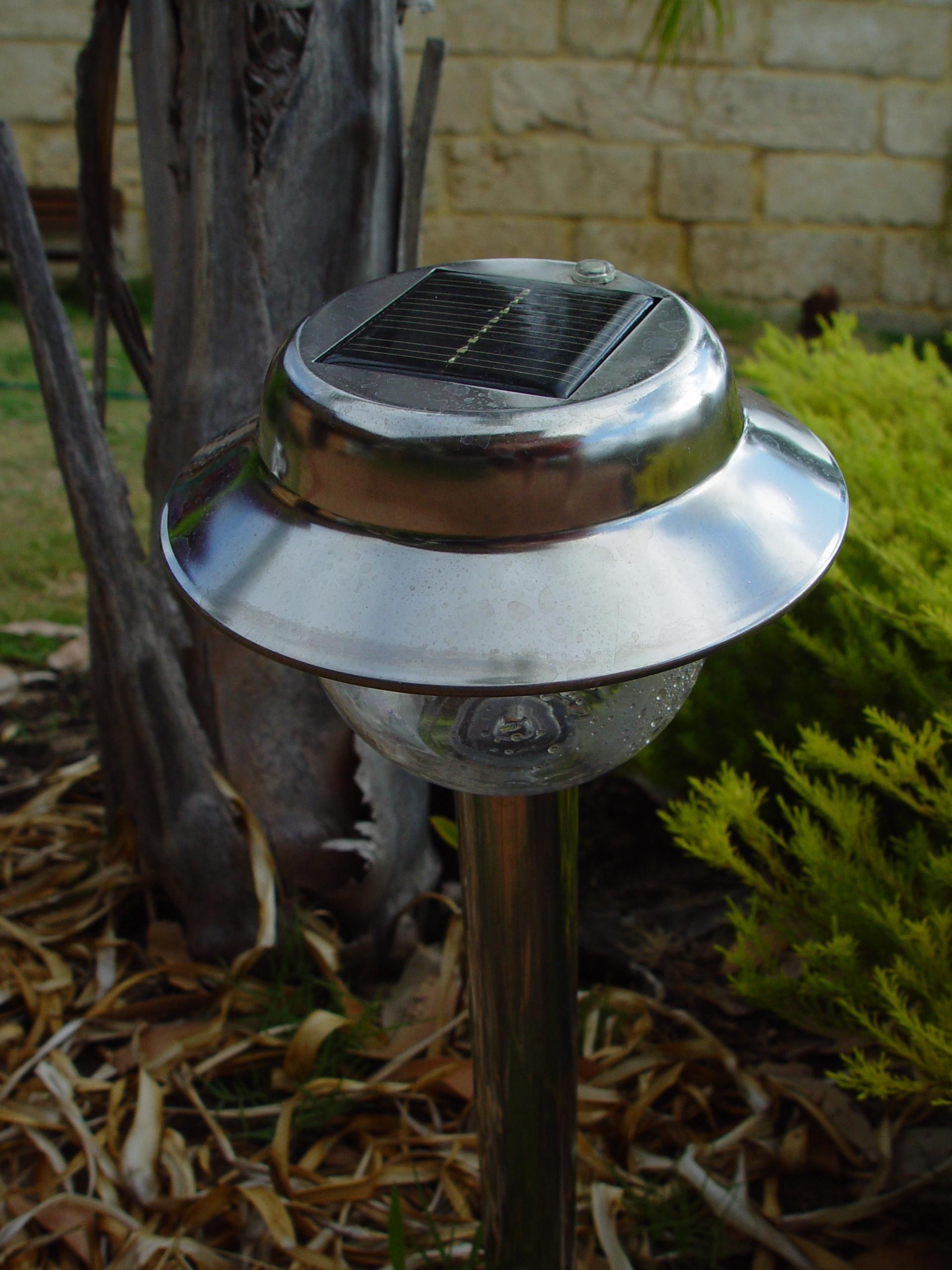
A solar garden light is a self-contained electrical system. It captures sunlight through a photovoltaic panel, stores the energy in a rechargeable battery, and releases that energy through an LED circuit after dark. No grid connection, no wiring run from the house, no transformer. Understanding each component clarifies both what a given product can realistically deliver and where common failures originate.
The Photovoltaic Panel
The panel in a typical garden stake light is small — usually between 0.5 W and 2 W — and constructed from polycrystalline or amorphous silicon cells. Polycrystalline cells are the more efficient of the two; amorphous panels are thinner and perform better under diffuse light, which matters in heavily overcast climates like coastal British Columbia.
The panel's job is to convert photons into direct current. Under full sun, a 1 W panel produces roughly 5–6 V open-circuit, which drops to around 3.5–4.5 V under load as it charges the battery. Output falls sharply with shade: even a single tree branch crossing the panel at midday can reduce output by more than half.
Panel Orientation and Tilt
In Canada, maximising irradiance means pointing the panel south and tilting it at an angle close to the site's latitude. In practice, most stake lights mount the panel horizontally or at a very shallow angle — convenient for manufacturing but suboptimal for energy collection north of 45° latitude. A panel oriented horizontally in Edmonton, Alberta collects noticeably less energy per day than one tilted at 50° south-facing, particularly in spring and autumn when sun angles are moderate.
The Rechargeable Battery
The battery stores energy during the day and supplies it at night. Two chemistries dominate garden lighting applications:
- NiMH (nickel-metal hydride): Found in the majority of inexpensive stake lights. Typical capacity runs from 400 mAh to 1200 mAh at 1.2 V. NiMH cells tolerate moderate cold (capacity falls at temperatures below 0°C but recovers when warmed). They have a cycle life of roughly 500–1000 full charge-discharge cycles before capacity degrades noticeably.
- LiFePO4 (lithium iron phosphate): Used in higher-end standalone systems. These cells operate closer to rated capacity at sub-zero temperatures compared to standard lithium-ion and offer cycle lives often exceeding 2000 cycles. They require a charge controller that understands lithium charging profiles — overcharging damages them.
Capacity determines how many hours a light can run. A 600 mAh NiMH cell powering a 0.1 W LED at 1.2 V delivers roughly 7 hours of runtime, assuming no energy losses in the circuit. In practice, controller and LED driver inefficiency reduces this to around 5–6 hours under real conditions.
Cold weather note: NiMH cells lose capacity at temperatures below −10°C. In parts of northern Ontario, Manitoba, and Saskatchewan where winter nights regularly reach −25°C to −30°C, expect significantly reduced or absent illumination from NiMH-based garden lights unless the battery is housed in an insulated enclosure.
The Charge Controller
Between the panel and the battery sits a small charge controller circuit — sometimes just a diode and resistor in the simplest products, sometimes a proper PWM (pulse-width modulation) or MPPT (maximum power point tracking) controller in more capable systems.
The charge controller prevents two problems:
- Overcharging: Left unchecked, a panel can push more current into a battery than the chemistry tolerates, degrading it quickly. A controller monitors voltage and limits current as the battery approaches full charge.
- Reverse discharge at night: Without a blocking diode, the battery discharges back through the panel in darkness. The controller (or a simple diode) prevents this drain.
The light-activation function is also handled here. Most garden light controllers include a light-sensing circuit — typically using the panel itself as a photosensor — that switches the LED circuit on when irradiance drops below a set threshold. This means a cloud passing overhead in mid-afternoon can briefly trigger the light on cheaper units.
The LED Driver and Light Output
The LED driver regulates current to the LED. LEDs are current-driven devices: connect them directly to a battery without current regulation and they either burn out immediately or underperform as the battery voltage drops through the night.
Modern garden lights use warm-white or neutral-white LEDs in the 3000–4000 K colour temperature range. Luminous output from a single stake light is modest — typically 5–30 lumens — sufficient to mark a path edge or illuminate a feature at close range but not to provide working light for outdoor tasks. Multi-light strings powered by a dedicated panel produce more aggregate lumens for the same or lower wattage per unit.

The Day-Night Cycle in Practice
Understanding the day-night cycle helps diagnose performance issues:
- Sunrise: panel voltage rises above battery voltage; charge current flows through the controller into the battery.
- Midday: peak irradiance, peak charge current. The controller begins tapering current as the battery approaches full voltage.
- Late afternoon: panel output falls; charge current reduces to near zero.
- Sunset: panel voltage falls below threshold; controller switches LED circuit on.
- Night: battery discharges steadily through the LED driver until either dawn (controller sees rising panel voltage, switches off LEDs) or until battery reaches the low-voltage cutoff.
If a light comes on during the day, the panel is likely shaded or degraded. If it turns off before sunrise, the battery lacks sufficient capacity for the night length — common in December at latitudes north of 50°N, where nights exceed 16 hours and solar irradiance is minimal.
Connector and Housing Quality
In Canada's climate, water ingress is the most common cause of premature failure. The IP rating printed on a product indicates resistance to dust and water: IP44 means the unit is splash-proof; IP65 provides full dust exclusion and resistance to water jets. Garden lights exposed to snow load and freeze-thaw cycles should be rated at least IP55. Connections between the panel lead and the battery housing are a common ingress point — a thin bead of silicone applied externally during installation extends service life.
What to Check When a Light Fails
When a solar garden light stops functioning:
- Clean the panel surface — a film of pollen, road dust, or bird droppings can reduce output by a material amount.
- Replace the battery before assuming anything else is faulty. Most failures are battery degradation after 2–4 years of cycling.
- Verify the installation location is receiving direct sun for at least 4–6 hours. Even partial shading reduces charging substantially.
- Check the light-sensing circuit by covering the panel completely — the light should activate within a few seconds if the LED and controller are functional.
For further reference on photovoltaic system fundamentals, the Natural Resources Canada solar energy resources provide a starting point for Canadian context, and the Government of Canada clean energy pages outline provincial solar resource variability.